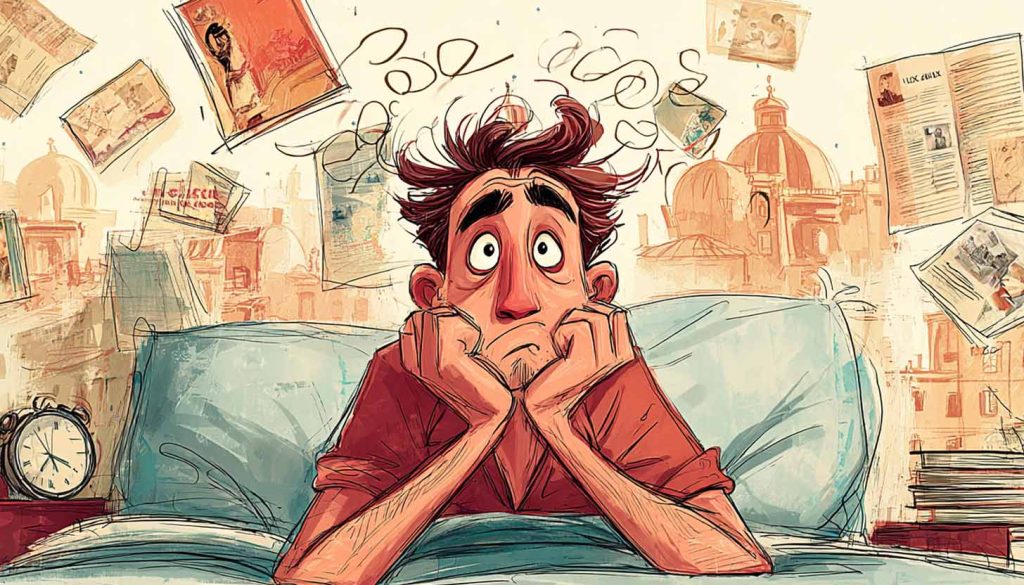
I pensieri ti tengono sveglia, almeno impariamo a coniugarli:
Thoughts keep you up at night, let’s at least conjugate them!
Ore 2:17: il cervello va in modalità “troppe finestre aperte”
2:17 a.m.: your brain goes into “too many windows open” mode
Se ti capita di essere pensierosa alle 2:17 di notte—quell’ora magica in cui il cervello decide di aprire dieci schede contemporaneamente—benvenuta nel club. Una scheda dice: “Ho risposto a quell’email?” L’altra: “Ho preso i biglietti?” E poi arriva la domanda che ti fa inciampare anche se studi italiano da anni: “Ho detto ci penso o penso di?”
If you ever find yourself “thoughtful” at 2:17 a.m.—that magical time when your brain opens ten tabs at once—welcome to the club. One tab says: “Did I answer that email?” Another: “Did I buy the tickets?” And then comes the question that trips you up even if you’ve studied Italian for years: “Did I say ci penso or penso di?”
E quando la mente parte in modalità sovrappensare (alias: “analizziamo tutto, subito, e possibilmente con ansia”), ti ritrovi circondata da una famiglia intera di verbi e sostantivi parenti di pensare. Non sono mostri: sono solo “cugini” che vogliono entrare nella conversazione al momento sbagliato. Tipo: ripensarci (ci ripenso e cambio idea), pensarci su (ci rifletto un attimo… o tre ore), ripensamento (ops, ho cambiato rotta), impensabile (neanche per sogno!), pensiero fisso (quello che non molla), pensiero ricorrente (il ritorno del pensiero, stagione 4), pensare troppo, pensare ad alta voce e persino pensare male (eh sì: in Italia si può fare anche quello!).
And when your brain flips into overthinking mode (aka: “let’s analyze everything, right now, with extra anxiety”), you suddenly meet the whole extended family of words related to pensare. They’re not monsters—just “cousins” who love to jump into the conversation at the worst moment. Like: ripensarci (rethink it and change your mind), pensarci su (think it over… briefly… or for three hours), ripensamento (oops, new plan), impensabile (no way!), pensiero fisso (the thought that won’t let go), pensiero ricorrente (the recurring thought—season 4), pensare troppo, pensare ad alta voce, and even pensare male (yes—Italian allows that too!).
Pensarci, pensare di, pensarne, pensare che:
four ways to “think” without losing your mind!
PENSARE + A ——> PENSARCI
(thinking about a task or something to do)

“Ci penso io” — Questo è l’italiano della vita vera: “Tranquilli, ci penso io.”
“Ci penso io” — This is real-life Italian: “Relax, I’ve got it.”
In Italian, pensare a means “to think about” a specific thing—a task, a responsibility, a plan, or an option already on the table. When that “thing” is understood from context, Italians often replace it with ci, and pensare a becomes pensarci: Ci penso = “I’ll think about it / I’ll take care of it / I’m considering it.”
pensarci : Task or responsibility
Hai pensato al biglietto? → Sì, ci ho pensato.
Did you think about the ticket? → Yes, I did / I considered it.
Devo pensare alla prenotazione. → Ci penso io.
I have to think about the reservation. → I’ll take care of it / I’ll handle it.
Pensiamo al programma per domani. → Ci pensiamo stasera.
Let’s think about tomorrow’s plan. → We’ll think about it tonight.
pensarci : Thinking about doing something (Previously referred to)
Pensi a comprare i biglietti online? → Sì, ci penso io.
Are you thinking about buying tickets online? → Yep, I’ll handle it.
Sto pensando a cambiare posto. → Ci sto pensando.
I’m thinking about changing seats. → I’m thinking about it.
Abbiamo pensato a partire dopo lo spettacolo. → Ci abbiamo pensato.
We thought about leaving after the show. → We considered it.
pensarci : Considering an option (Previously referred to)
Pensi a venire al concerto? → Sì, ci penso. (= ci sto valutando)
Are you considering coming to the concert? → Yeah, I’ll think about it.
Hai pensato a una soluzione? → Ci sto pensando.
Did you think of a solution? → I’m thinking about it.
Pensate a un altro film? → Sì, ci pensiamo.
Are you considering another movie? → Yes, we’ll think about it.
PENSARCI : Imperative / Command Tense
Reminder: “Don’t forget / think it through!”
When pensare a turns into the imperative—“Pensaci!”—it’s not just “think about it.” It works as a quick reminder (don’t forget!) or a nudge to think it through before you decide. It’s like saying: “Hey—keep it in mind… and think twice.”
Mi mandi il link del trailer? Pensaci! (= non dimenticare)
Will you send me the trailer link? Remember!
Quando arrivi, pensaci: devi spegnere il telefono.
When you arrive, remember: you must turn off your phone.
Pensaci bene prima di comprare i posti in galleria. (= riflettici)
Think it through before buying the balcony seats.
PENSARE + DI
(intention or planning to do something)

PENSARE DI: il piano che ti fai in testa (prima che la realtà intervenga)
PENSARE DI: the plan you make in your head (before reality steps in)
Pensare di is your go-to structure for expressing an intention, plan, or likely future action: “I intend to / I’m planning to / I think I will do X.” It’s followed by an infinitive (andare, fare, prenotare, chiamare…), and it lives entirely in your head as a decision-in-progress.
The key point: with pensare di, there’s usually no specific “thing” already mentioned that you’re referring back to—so there’s nothing to replace with ci. You’re not saying “I’ll think about that”; you’re saying what you believe you’re going to do.
PENSARE DI + INFINITO
intention or Planning to do something
Penso di andare in Italia quest’estate.
I’m planning to go to Italy this summer.
Pensiamo di vedere un film dopo cena.
We’re thinking of watching a movie after dinner.
Penso di prenotare online.
I think I’ll book online.
PENSARE + NE
(your opinion of something)

PENSARNE: “ne” = il tuo verdetto (mi piace, non mi piace, boh)
PENSARNE: “ne” = your verdict (love it, hate it, meh)
Pensarne is what happens when pensare teams up with ne to express an opinion. Think of it as Italian’s compact way to say: “What do you think of it?” or “What’s your opinion about…?”
The little word ne points back to something already mentioned (or about to be mentioned), and it usually corresponds to what would be introduced with di: di questo, di quel film, di quell’idea. That’s why you’ll hear questions like:
PENSARE + NE
your opinion (of something)
Domande tipiche / Typical questions
Che ne pensi del film?
What do you think of the movie?
Che ne pensate di andare a teatro?
What do you think about going to the theater?
Come rispondere / How to answer
Ne penso bene. (mi piace / buona opinione)
Ne penso bene. (I like it / good opinion)
Ne penso male. (non mi piace / cattiva opinione)
Ne penso male. (I don’t like it / bad opinion)
Non ne penso molto / granché. (non mi impressiona)
Non ne penso molto / granché. (I’m not impressed)
PENSARE + CHE
(I think that… + a full clause)

PENSARE CHE: quando “I think” apre un mini-film (con indicativo o congiuntivo!)
PENSARE CHE: when “I think” launches a mini-movie (indicative or subjunctive!)
Pensare che is the structure you use when your thought isn’t just “to do something,” but a full idea you want to state out loud. It introduces a complete clause—a mini sentence with a subject + verb.
And this is where the Italian soap opera begins: after penso che, do you use the indicative or the subjunctive (congiuntivo)?
In everyday conversation, many Italians often use the indicative because it feels quick and natural, especially when the speaker believes something is likely true (Penso che è tardi). But in more careful speech and in writing, the “classic” choice is the subjunctive, because penso che expresses an opinion, uncertainty, or a personal viewpoint (Penso che sia tardi).
A helpful rule of thumb: when your sentence is clearly subjective —and especially when it’s negative—Italian strongly leans toward the congiuntivo:
PENSARE CHE + a full clause
(I think that / A personal opinion)
++++++++++++++++++++++++++++++++++++++++++++
Indicative — very common in speech.
Many Italians use the indicative in everyday conversation
when it feels “likely true,” or simply because it’s fast and natural.
Penso che è un bel film.
think it’s a good movie.
Penso che domani piove.
I think it’s going to rain tomorrow.
Penso che loro arrivano tardi.
I think they’re arriving late.
++++++++++++++++++++++++++++++++++++++++++++
Subjunctive — more standard / more polished
Traditionally, after “penso che” (opinion, subjectivity), writing and
careful speech prefer the subjunctive. With negation it is extremely common
Penso che sia un bel film.
I think it’s a good movie.
Penso che domani piova.
I think it’ll rain tomorrow.
Penso che arrivino tardi.
I think they’re arriving late.
Non penso che sia vero.
I don’t think it’s true.
Non penso che venga stasera.
I don’t think he/she is coming tonight.
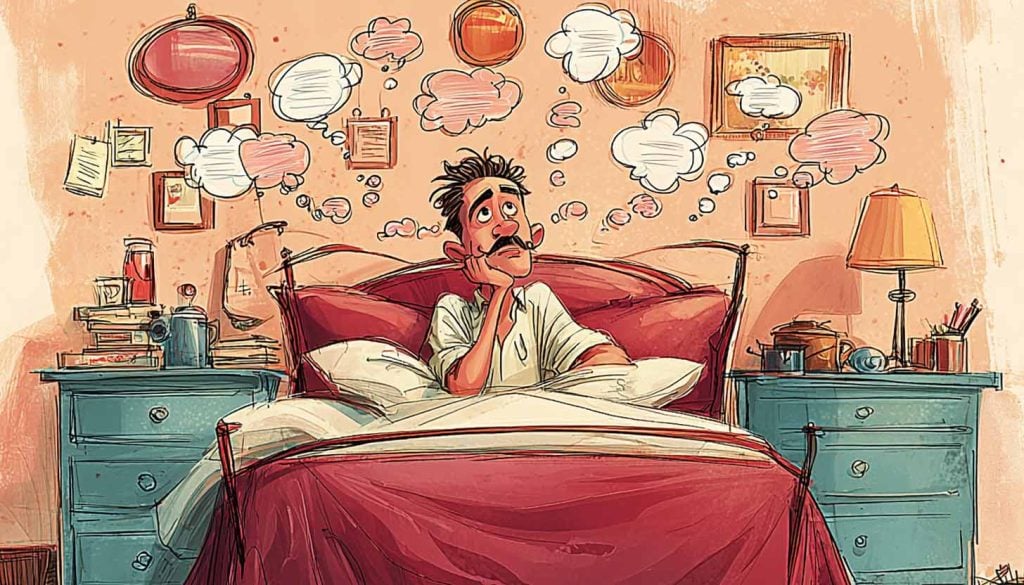
Pensieri notturni? Tisana, sorriso, e la frase magica: “Ci penso domani.”
Night thoughts? Herbal tea, a smile, and the magic phrase: “Ci penso domani.”
Se stasera i pensieri tornano a bussare (“E se avessi detto penso che è invece di penso che sia?!”), fai così: una tisana, un sorriso, e ripeti come un mantra: “Ci penso domani.” (E guarda: hai appena usato pensarci perfettamente.)
If tonight your thoughts come knocking again (“What if I said penso che è instead of penso che sia?!”), do this: herbal tea, a smile, and repeat like a mantra: “Ci penso domani.” (And look: you just used pensarci perfectly.)
🇮🇹 Un consiglio dalla Matta 🇮🇹
Matta Italian Language Tip!

Quick Guide how to Use PENSARE
So you can get some sleep at night!
PENSARCI → think about that thing / handle it / consider it
La prenotazione? → Ci penso io.
The reservation? → I’ll handle it.
PENSARE DI → intention/plan + infinitive
Domani che fai? → Penso di andare al museo.
What are you doing tomorrow? → I’m planning to go to the museum.
PENSARNE → opinion (“What do you think of…?”)
Il museo com’è? → Ne penso benissimo!
How’s the museum? → I think it’s great!
PENSARE CHE → “I think that…” + full clause (indicative/subjunctive)
Vale i soldi? → Penso che sia un’esperienza unica.
Is it worth the money? → I think it’s a unique experience.
Another Matta Tip: If you’d like to print or create a PDF of this post you can easily do so using the Chrome Browser Extension —-> GoFullPage! It works beautifully!