Guest Post by Serena Capilli for the Matta Blog
How to Stop Forgetting Italian Vocabulary (and Finally Make It Stick)
Cosa succede quando due insegnanti di italiano collaborano?
Un apprendimento migliore per gli studenti!
What Happens When Two Italian Teachers Collaborate? Better Learning for Students!
Oggi sono felice di dare il benvenuto a Serena Capilli sul Matta Blog, dove condivide con noi un guest post che ha scritto su come smettere di dimenticare il nuovo vocabolario italiano che impari.
Today I’m happy to welcome Serena Capilli to visit the Matta Blog and share with us a guest post she has written about “How to Stop Forgetting the New Italian Vocabulary You Learn”
Serena e io siamo amiche da tempo e, recentemente, abbiamo messo insieme le nostre idee e deciso di collaborare a un progetto per aiutare i nostri studenti a imparare l’italiano seguendo le migliori pratiche di apprendimento. Io ho scritto un guest post per il suo sito Italian Pills intitolato “The Matta Method: Best Ways to Learn Italian at Home” e lei ha scritto per me un guest post intitolato “How to Stop Forgetting the New Vocabulary You Learn”.
Serena and I have been friends for a while and recently we put our heads together and decided to collaborate on a project to help our students learn Italian using our Ideas for best learning practices. I wrote a guest post for her site Italian Pills called “The Matta Method: Best ways to learn Italian at home” and she has written a guest post for me called “How to Stop Forgetting the New Vocabulary You Learn.”
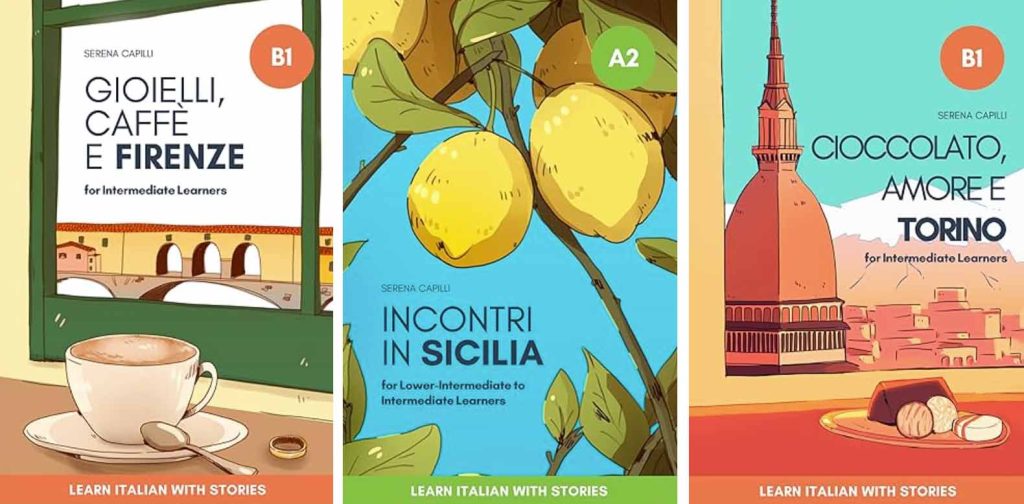
Serena Capilli è un’insegnante di italiano e autrice con sede a Roma che aiuta gli studenti a smettere di dimenticare ciò che studiano, concentrandosi sulla comprensione, sulla ripetizione e sull’uso reale della lingua. Cura il sito di apprendimento della lingua italiana ItalianPills.com ed è autrice di una serie di libri per studenti principianti di italiano, disponibili su Amazon.
Serena Capilli is an Italian teacher and author based in Rome who helps learners stop forgetting what they study by focusing on comprehension, repetition, and real language use. She curates the Italian language-learning website ItalianPills.com and is the author of a series of books for beginning Italian students, available on Amazon.
Serena è anche la creatrice di Piazzetta Italiana, una rivista di lingua italiana con audio, scritta in un italiano chiaro e accessibile. La rivista è pensata per aiutare gli studenti a rinforzare in modo naturale il vocabolario e la grammatica che già conoscono, senza sovraccaricarli o ricorrere a una memorizzazione noiosa.
She is also the creator of Piazzetta Italiana, a language magazine with audio written in clear, accessible Italian. The magazine is designed to help students naturally reinforce the vocabulary and grammar they already know—without overwhelming or tedious memorization.
Ecco Serena! She shares her thoughts on learning new vocabulary!
Guest Post by Serena Capilli

How to Stop Forgetting the New Vocabulary You Learn
If you’ve ever learned a new Italian word on Monday and completely forgotten it by Wednesday, don’t worry—it’s perfectly normal.
I’ve been teaching Italian for many years, and one of the most common frustrations I hear from students sounds like this:
“I learned this three days ago—why can’t I use it today?”
The truth is, there’s nothing wrong with your memory.
What I tell my students again and again is this: the real problem isn’t a lack of effort. It’s a lack of repeated, meaningful exposure. In other words, you’re not encountering the same word or grammatical structure often enough—and not in enough varied but understandable contexts—for it to truly stick.
So what’s the most natural way to get that kind of exposure?
Reading!
More specifically, reading simple Italian.
And by the way, this is exactly what teachers and parents encouraged
us to do in our native language to improve vocabulary and expression—for very good reason.

Why Your Brain Forgets Vocabulary
When you learn vocabulary from a list or a flashcard, your brain tends to store it in a temporary, surface-level way. You might recognize the word, but you’re not quite ready to use it.
It’s there… but it’s not available when you need it. And that’s completely normal.
This is why you can understand a word when you read it or hear it, but struggle to recall it in conversation. The word lives in your passive memory, not your active memory.
Your brain doesn’t store language deeply if it can’t connect it to meaning. And this is exactly where reading simple stories changes everything.
Why do we forget vocabulary? Because isolated words are:
Context-free
Emotionless
Disconnected
Hard to recall
Why Reading Works (When It’s Done Right)
Reading helps your brain connect the dots—but only if the text is simple enough, and you read regularly:
Simple reading allows you to encounter the same words and structures again and again, each time in a slightly different context.
This repetition with variation is what moves vocabulary from passive to active—and finally makes it usable when you want to speak.
How to Use Reading in Simple Italian to Remember Vocabulary
Here’s the routine I teach Italian learners at every level:
1. Choose very simple texts
Yes — simpler than you think.
Aim to understand 70–85% without a dictionary.
If a text feels dense or overwhelming, it’s too hard.
2. Read for the message, not for perfection
Do not stop for every unknown word.
Your brain learns more from flow than from constant interruption.
3. Re-read the text
This is where vocabulary starts to stick.
Familiar content + new attention = acquisition.
4. Notice repeated phrases
This is your built-in vocabulary lesson.
5. Keep texts short
You don’t need a novel.
You need something you can finish in days, not months.
6. Talk about what you’ve read
This is where the real magic happens.
Why Simple Stories Are So Effective
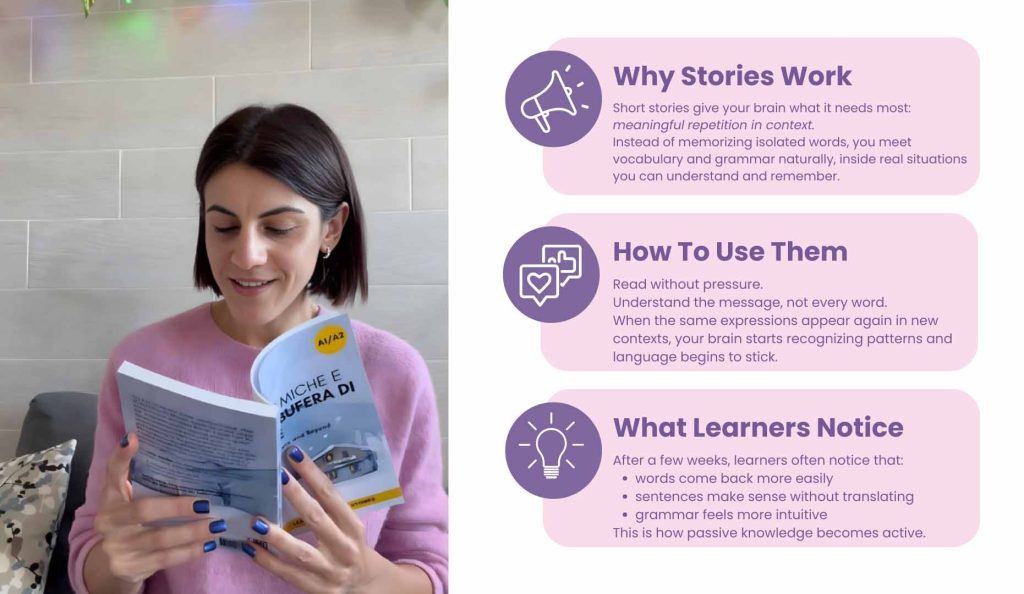
When you read simple Italian stories, you encounter the same vocabulary and grammar you’ve already studied—but this time they appear in new sentences and fresh situations. Instead of existing in isolation, the language is embedded in meaningful contexts, which helps your brain understand not just what the words mean, but how they are actually used.
The key to word retention
Short stories, graded readers, and simple texts work
because they provide words you are learning:
in new sentences
in new situations
in meaningful contexts
Reading stories geared to your language level are fantastic because:
they’re easy to digest
they’re not overwhelming
they’re portable and affordable
and most importantly, they’re understandable

What’s happening in your brain when you read a short story
When words appear in context—inside meaningful sentences—they become easier to understand and remember. Through reading, you get natural repetition without drills or forced exercises. Stories create images in your mind, and those images significantly strengthen memory.
You’ll see the same word again and again, but each time it appears slightly differently. This kind of gentle variation—often called novel repetition—is the real secret to vocabulary acquisition.
The truth is, you don’t need more words. You need to integrate the ones you already know. And simple stories do exactly that—without making repetition feel like repetition.

What You’ll Notice After a Few Weeks
When you start reading simple Italian on a regular basis, something begins to shift. Words you used to forget suddenly start to stick. Vocabulary comes back to you without effort, and you find yourself understanding sentences without mentally translating every word.
At the same time, grammar starts to make sense in a more natural way—not because you’ve memorized rules, but because you’ve seen those structures used again and again in context.
After reading short stories you will soon notice:
Words you used to forget suddenly stick
You recall vocabulary without effort
You understand sentences without translating
Grammar starts to make sense naturally
It’s not magic. It’s simply the difference between
studying words and experiencing them.
And that’s where real language learning truly begins.
Grazie Serena!
Un grande grazie a Serena per aver condiviso sul Matta Blog le sue preziose strategie di apprendimento e la sua esperienza da insegnante. Quando due prof di italiano si confrontano, nascono sempre idee intelligenti, pratiche e—soprattutto—utili per gli studenti. Grazie, Serena, per aver portato qui la tua passione, la tua chiarezza e il tuo amore per un italiano che si impara davvero… e che finalmente resta!
A big thank you to Serena for sharing her best learning practices here on the Matta Blog. When two Italian teachers come together, smart, practical ideas are bound to follow—and most importantly, ideas that truly help students learn. Thank you, Serena, for bringing your passion, clarity, and love for an Italian that’s not just studied, but truly learned—and remembered!
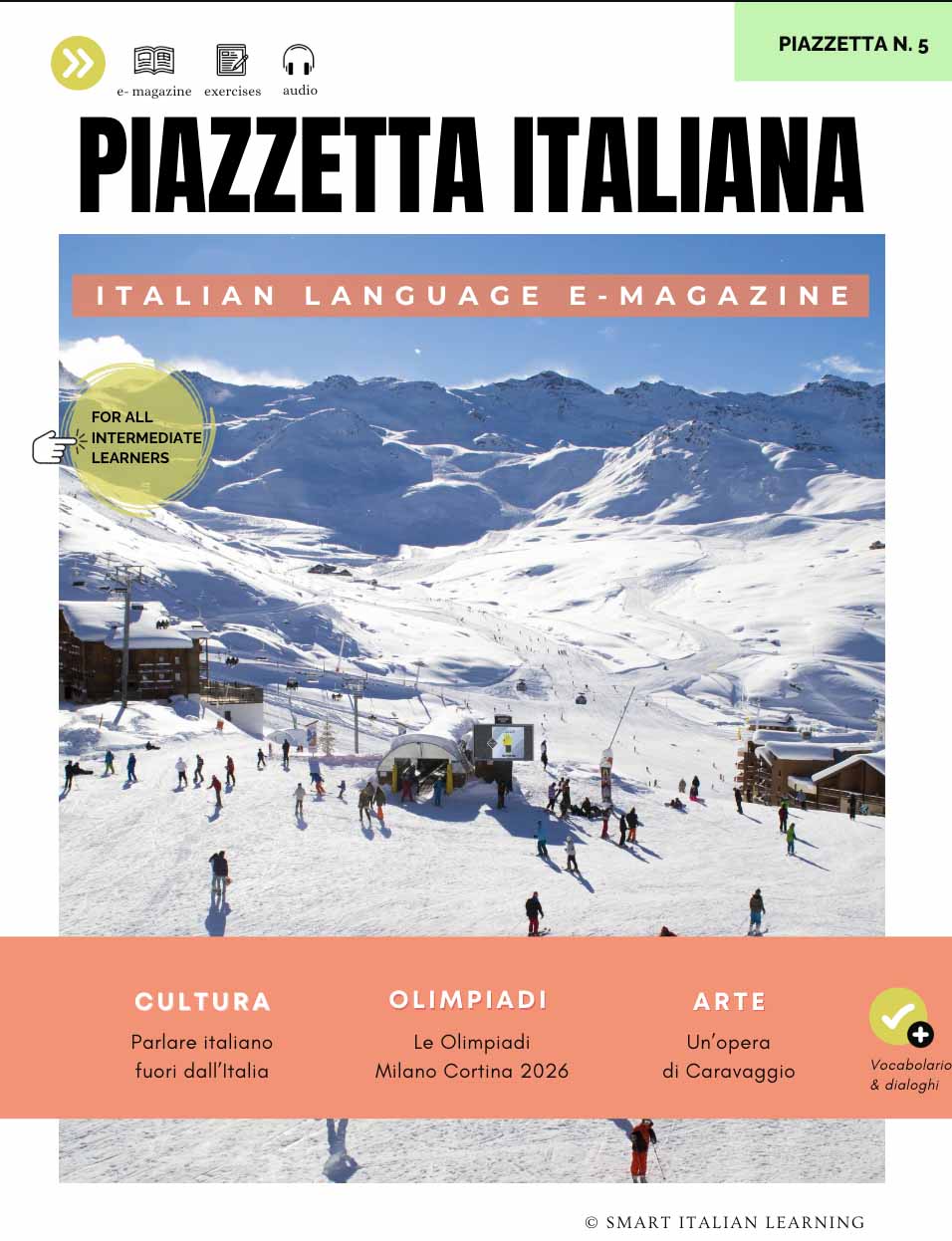
Subscribe to “Piazzetta Italiana” e-magazine with audio
Piazzetta Italiana e-magazine
By Serena Capilli
Piazzetta Italiana is a lovely publication in which Serena explores all aspects of Italy: its culture, everyday life, places to visit in the bel Paese, and charming cultural anecdotes. As you read and listen, you not only deepen your knowledge of Italy but also strengthen your Italian reading and listening skills.
Introduce Sofia to your big or little language learner! Simple stories. Grammar made fun!
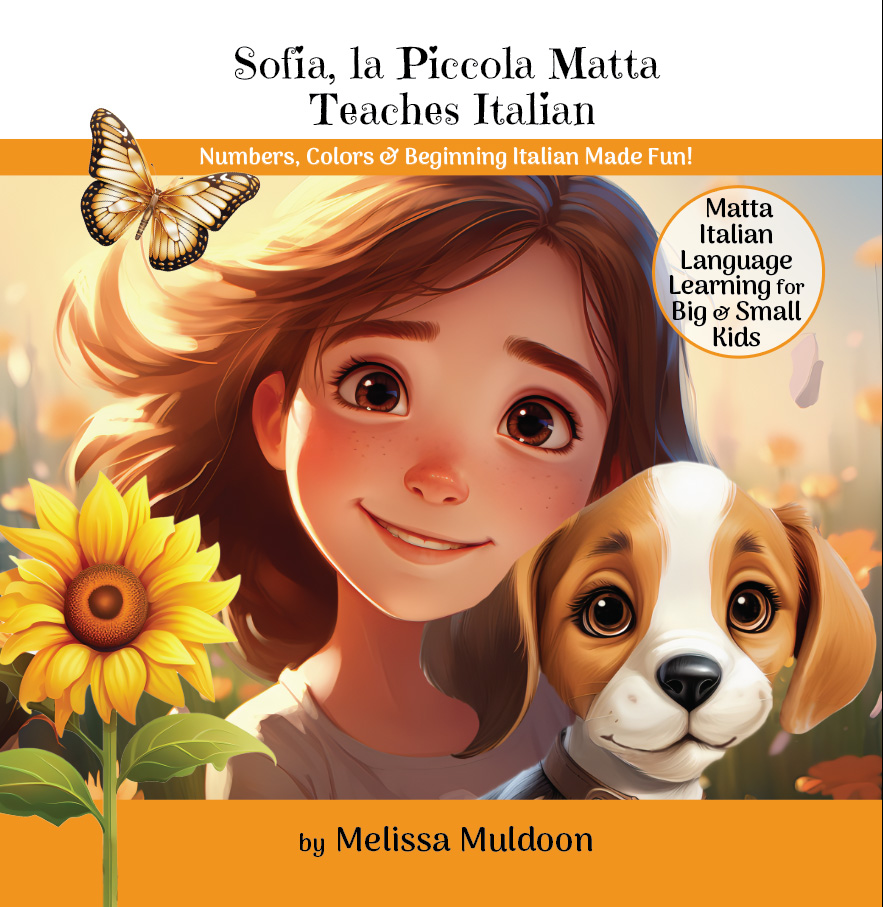
Sofia, la Piccola Matta Teaches Italian
Numbers, Colors & Beginning Italian Made Fun!
Matta Italian Language Learning for Big & Small Kids
By Melissa Muldoon
Join Sofia and her beagle, Moka, on a captivating journey through Italy in the children’s book “Sofia, la Piccola Matta Teaches Italian: Numbers, Colors & Beginning Italian Made Fun!” Discover language lessons intertwined with adventures in Tuscany’s hills and markets. Perfect for young learners eager to explore Italian culture and language.